

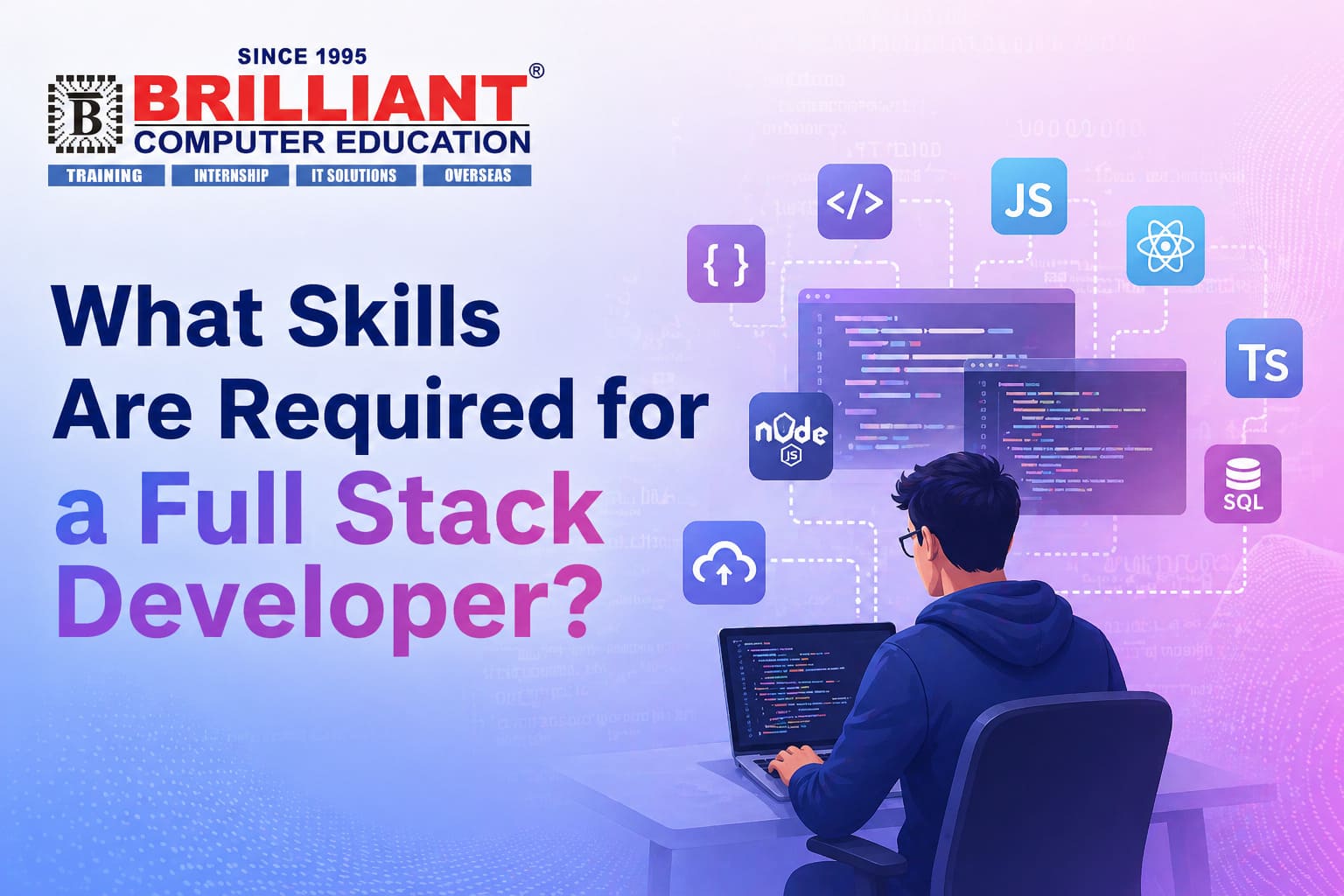
What Skills Are Required for a Full Stack Developer? – Complete 2026 Guide
In today’s rapidly evolving digital landscape, full stack development has emerged as one of the most sought-after career paths in the IT industry. Businesses are increasingly looking for professionals who can manage both front-end and back-end development efficiently. This demand makes full stack developers highly valuable, versatile, and future-ready.
If you're planning to enter the tech industry, a key question arises: what skills are required to become a successful full stack developer?
This detailed guide by Brilliant Computer Education will walk you through the essential technical skills, soft skills, tools, and career roadmap you need to build a strong full stack development career in 2026 and beyond.
What is a Full Stack Developer?
A full stack developer is a professional who can work on both the front-end (client side) and back-end (server side) of web applications. They are also responsible for managing databases, APIs, and deployment processes.
Because they can handle complete application development, full stack developers are in high demand across startups, IT companies, and large enterprises.
Why Skills Matter More Than Degrees
While a formal degree like B.Tech or B.Sc in Computer Science can be helpful, most companies today prioritize practical skills, real-time project experience, and problem-solving ability.
Having strong skills can help you:
- Secure high-paying IT jobs
- Crack technical interviews with confidence
- Build real-world applications
- Develop scalable and efficient systems
Core Skills Required for Full Stack Developers
To become a job-ready full stack developer, you need to master multiple skill areas.
1. Front-End Development Skills
Front-end development focuses on designing what users see and interact with.
Key Skills:
- HTML – Structuring web pages
- CSS – Styling and responsive design (Flexbox, Grid)
- JavaScript – Adding interactivity, DOM manipulation, event handling
Popular Frameworks & Libraries:
- React.js
- Angular
- Vue.js
These tools help you create modern, fast, and dynamic user interfaces.
2. Back-End Development Skills
Back-end development manages server-side logic and application functionality.
Popular Technologies:
- Node.js
- Python
- Java
- PHP
Important Concepts:
- Server management
- Authentication & authorization
- API development
- Business logic handling
3. Database Management Skills
A full stack developer must know how to store, retrieve, and manage data effectively.
Types of Databases:
SQL Databases:
- MySQL
- PostgreSQL
NoSQL Databases:
- MongoDB
Required Skills:
- Writing efficient queries
- Data modeling
- Database optimization
4. Version Control Systems
Version control helps manage code changes and collaboration.
Tools:
- Git
- GitHub
5. API Development & Integration
APIs connect different parts of an application.
Skills Needed:
- RESTful API development
- API testing
- Front-end integration
6. DevOps & Deployment Basics
Understanding deployment makes you a complete developer.
Tools & Platforms:
- Docker
- CI/CD pipelines
- Cloud services (AWS, Azure)
7. Data Structures & Algorithms (DSA)
DSA is crucial for problem-solving and technical interviews.
Important Topics:
- Arrays
- Linked Lists
- Trees
- Sorting & Searching
Strong DSA knowledge improves coding efficiency and logic building.
8. Web Architecture Knowledge
Understanding how web applications function is essential.
Key Concepts:
- Client-server architecture
- HTTP/HTTPS protocols
- MVC architecture
9. Testing & Debugging
Testing ensures your application runs smoothly.
Skills:
- Debugging errors
- Unit testing
- Performance optimization
10. Security Fundamentals
Security is critical in modern web applications.
Basic Knowledge:
- Data protection techniques
- Authentication methods
- Preventing attacks like XSS and SQL injection
Advanced Skills to Stand Out
- Cloud Computing (AWS, Azure)
- DevOps practices (CI/CD)
- Microservices architecture
- Progressive Web Apps (PWA)
- Basics of AI & Machine Learning
Essential Soft Skills for Developers
- Problem-solving ability – Analyze and fix issues efficiently
- Communication skills – Work effectively in teams
- Time management – Meet deadlines
- Team collaboration – Work on group projects
- Adaptability – Keep learning new technologies
Tools Every Full Stack Developer Should Use
- Code Editor: VS Code
- Version Control: Git
- Browser DevTools
- API Testing: Postman
- Package Managers: npm, yarn
Step-by-Step Roadmap to Become a Full Stack Developer
- Step 1: Learn basics – HTML, CSS, JavaScript
- Step 2: Master a front-end framework – React or Angular
- Step 3: Learn back-end development – Node.js or Python
- Step 4: Understand databases – MySQL or MongoDB
- Step 5: Build real-world projects
- Step 6: Learn deployment & cloud basics
- Step 7: Practice DSA for interviews
Common Mistakes to Avoid
- Trying to learn too many technologies at once
- Ignoring fundamentals
- Not building practical projects
- Skipping DSA preparation
- Not updating skills regularly
Career Opportunities in Full Stack Development
- Full Stack Developer
- Front-End Developer
- Back-End Developer
- Software Engineer
- Web Developer
- Technical Lead
Salary Based on Skill Level
- Beginner: ₹3 – ₹5 LPA
- Intermediate: ₹5 – ₹10 LPA
- Advanced: ₹10 – ₹25+ LPA
Your salary largely depends on your skills, experience, and project portfolio.
Future Scope of Full Stack Development
- Rapid digital transformation
- Rise of startups
- Increasing web and mobile applications
- Growth of cloud computing and AI
Benefits of Learning Full Stack Development
- High job demand
- Attractive salary packages
- Multiple career options
- Freelancing opportunities
- Remote work flexibility
Conclusion
Becoming a successful full stack developer requires a combination of front-end, back-end, database, and deployment skills. Along with technical expertise, strong soft skills and continuous learning are essential for long-term success.
At Brilliant Computer Education, we focus on practical training, real-time projects, and industry-ready skills to help students build successful IT careers.
If you stay consistent, build real-world projects, and keep upgrading your skills, full stack development can open doors to high-paying and rewarding job opportunities.